

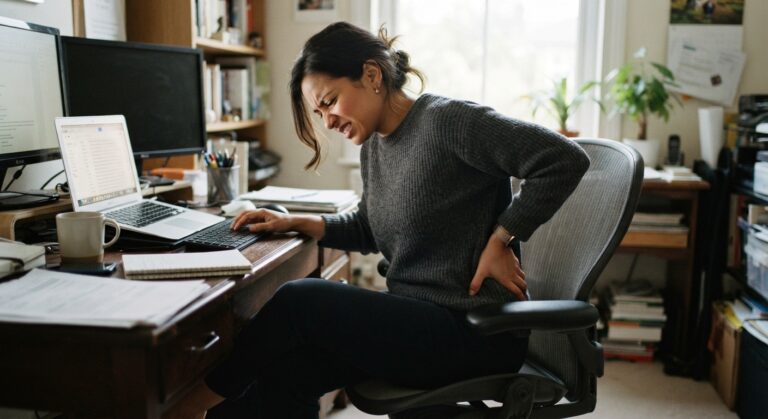
Why Does My Lower Back Hurt When I Sit?
Does your lower back start aching after sitting at your desk for a few hours? Maybe you feel stiff when getting out of your car, or you notice that standing up after watching television is becoming increasingly uncomfortable.
For some people, the pain disappears once they start moving. For others, it lingers throughout the day or even travels into the buttocks or legs.
If this sounds familiar, you’re not alone.
Lower back pain while sitting can result from prolonged positioning, muscle fatigue, joint irritation, disc-related problems, or other underlying conditions. Sitting isn’t necessarily harmful to your spine, but remaining in one position for extended periods can aggravate certain problems.
At West Coast Chiropractic Center here in Carlsbad, we believe understanding why your back hurts is the first step toward finding the right treatment.
We test, we don’t guess.
Why Does Sitting Make My Lower Back Hurt?
Your spine is designed to support movement and tolerate a variety of positions throughout the day.
When you sit, your lower back, pelvis, hips, and surrounding muscles work together to maintain your position.
Depending on how you’re sitting, how long you’ve been sitting, and whether you have an underlying spinal condition, certain tissues may become uncomfortable.
Several factors can contribute to pain.
1. Staying in One Position Too Long
Even a comfortable sitting position can become uncomfortable when maintained for an extended period.
Your muscles may become fatigued, and certain joints or tissues may become sensitive to sustained loading.
That’s why many people feel better after standing up, stretching, or taking a short walk.
The goal isn’t to maintain one perfect posture all day. It’s to change positions regularly.
2. Disc-Related Problems
Between most of your spinal vertebrae are intervertebral discs that help distribute forces and allow movement.
Certain sitting positions, particularly prolonged slouched or flexed positions, can aggravate symptoms in some people with disc-related problems.
A bulging or herniated disc may also irritate nearby nerve structures.
Possible symptoms include:
- Lower back pain that increases with sitting.
- Pain traveling into the buttock or leg.
- Tingling or numbness in the leg or foot.
- Discomfort when bending forward or standing up.
However, not every disc bulge causes pain, and symptoms alone cannot confirm a disc problem.
A proper examination is important before deciding what treatment may help.
3. Muscle Fatigue and Reduced Movement
The muscles supporting your spine and pelvis help maintain stability during everyday activities.
When you remain seated for long periods, some muscles maintain low-level activity while others move very little.
This can contribute to stiffness, fatigue, or discomfort.
Reduced physical activity and limited movement throughout the day may also affect how comfortably your back tolerates sitting.
Regular movement, appropriate exercise, and gradual strengthening may help improve your ability to tolerate daily activities.
4. Irritation of Spinal Joints
The small joints in your lower back help guide movement and contribute to spinal stability.
Some people experience pain associated with these joints, particularly during certain positions or movements.
However, pain that occurs while sitting does not automatically mean a spinal joint is the cause.
The location of your symptoms, your movement patterns, and your examination findings help us evaluate possible sources of discomfort.
5. Hip and Pelvic Problems
Not all pain felt in the lower back actually begins in the spine.
Hip joint problems, surrounding muscles, and other structures near the pelvis can sometimes produce symptoms that feel like lower back pain.
For example, limited hip movement or discomfort around the buttocks may change how you sit and move.
That’s one reason we evaluate more than just the painful area.
Why Does My Back Hurt When I Stand Up After Sitting?
This is one of the most common complaints we hear from patients.
You may sit comfortably for a while, but when it’s time to stand, your lower back feels stiff, tight, or painful.
Sometimes you need a few steps before you can straighten up comfortably.
There are several possible explanations.
Remaining seated for a prolonged period may temporarily increase stiffness or sensitivity in certain spinal and surrounding tissues.
Standing up also requires your hips, pelvis, and lower back to transition from a relatively stationary position into movement.
If those structures are already irritated, the transition can be uncomfortable.
For some patients, symptoms improve after walking for a few minutes. Others experience persistent pain or discomfort that increases with activity.
The way your symptoms change when you sit, stand, and walk can provide useful clues about the underlying problem.
Can Sitting Cause Sciatica?
Sitting does not necessarily cause sciatica, but it can aggravate sciatic symptoms in some people.
Sciatica commonly involves pain that travels from the lower back or buttock into one leg.
Some patients also experience numbness, tingling, or weakness.
A herniated lumbar disc is one possible cause. Other conditions can also irritate the nerve roots that contribute to the sciatic nerve.
If your pain extends below your buttock into your thigh, calf, or foot, a neurological examination may be appropriate.
You can learn more in our article, What Causes Sciatica and How Do You Know If You Have It?
It’s important to remember that not every case of leg pain is sciatica, and not every patient with sciatica has a herniated disc.
Is Sitting Bad for Your Spine?
No. Sitting is a normal part of daily life.
Your spine is capable of tolerating sitting, standing, bending, lifting, and many other activities.
Problems are more likely to arise when a particular position aggravates an existing condition or when you’re unable to vary your movement comfortably.
There is no single sitting posture that prevents back pain for everyone.
Instead of trying to sit perfectly straight all day, focus on finding a comfortable position, adjusting your workspace, and moving regularly.
For many people, changing positions is more practical than trying to maintain a rigid posture.
What Can I Do to Reduce Lower Back Pain While Sitting?
If your symptoms are mild and you don’t have concerning neurological signs, several practical changes may help.
Take Regular Movement Breaks
Try standing up or walking briefly every 30–60 minutes.
This isn’t a strict medical rule, but it’s a useful starting point for breaking up prolonged sitting.
Even a short walk around your office or home may help reduce stiffness.
Adjust Your Chair and Workstation
A supportive workstation can make sitting more comfortable.
Consider these adjustments:
- Keep your feet comfortably supported.
- Position your keyboard and mouse so your shoulders can remain relaxed.
- Place your screen at a comfortable viewing height.
- Use a chair that supports your back without forcing an uncomfortable posture.
- Adjust your seat height so standing up and sitting down feel natural.
The best setup is one that allows you to work comfortably and change positions throughout the day.
Stay Physically Active
Walking, appropriate strengthening exercises, and regular physical activity can help support back health.
Exercise selection should reflect your symptoms, physical abilities, and medical history.
If a particular exercise increases radiating leg pain, numbness, or weakness, stop and seek professional guidance.
Pay Attention to Symptom Patterns
Notice when your pain occurs.
Does it begin after 15 minutes of sitting or after several hours?
Does standing improve it?
Does walking help?
Does the pain travel down your leg?
These details can help your healthcare provider understand what may be contributing to your symptoms.
When Should I See a Chiropractor for Lower Back Pain?
Occasional mild stiffness after sitting may improve with movement and simple adjustments to your daily routine.
However, an evaluation may be appropriate when:
- Your pain keeps returning.
- Sitting interferes with your work or daily activities.
- You frequently feel stiff or painful when standing up.
- Symptoms persist despite reasonable self-care.
- Pain travels into your buttock or leg.
- You experience recurring numbness or tingling.
New or worsening weakness should be assessed promptly, and rapidly progressive neurological symptoms require urgent evaluation.
At West Coast Chiropractic Center, we begin by understanding your symptoms and performing an examination to identify possible causes.
We don’t assume that everyone with lower back pain has the same problem.
How We Evaluate Sitting-Related Lower Back Pain
Our approach begins with a conversation about your symptoms, health history, and daily activities.
We want to understand how long you’ve been experiencing discomfort, which positions aggravate it, and whether you’re experiencing symptoms elsewhere.
Depending on your findings, the examination may include:
- Spinal movement and functional assessment.
- Orthopedic testing.
- Neurological testing when indicated.
- Evaluation of hip and pelvic movement.
- Review of previous injuries or imaging studies.
West Coast Chiropractic Center has in-house digital X-ray capabilities when radiographs are clinically indicated.
However, not everyone with lower back pain needs imaging.
If examination findings suggest a condition requiring MRI or evaluation by another healthcare professional, we can discuss appropriate next steps.
Treatment recommendations depend on what we find.
For some patients, chiropractic care may be appropriate. Others may benefit from exercise-based rehabilitation, activity modification, or additional evaluation.
Spinal decompression may be considered for selected patients with certain disc-related symptoms, but it isn’t a routine treatment for every case of lower back pain.
Understand first. Treat second.
When Should Lower Back Pain Be Considered an Emergency?
Most lower back pain is not caused by a dangerous medical condition.
However, certain symptoms require immediate attention.
Seek emergency medical care if you experience:
- New loss of bladder or bowel control.
- Numbness around the groin or saddle region.
- Rapidly worsening weakness in one or both legs.
- Severe neurological changes following significant trauma.
Back pain accompanied by fever, unexplained weight loss, or a history of cancer also deserves timely medical evaluation.
Do not delay medical care if you’re experiencing serious or rapidly worsening symptoms.
Frequently Asked Questions About Lower Back Pain While Sitting
Why does my lower back hurt when I sit but feel better when I stand?
Sitting may aggravate certain muscles, joints, or spinal structures, especially when you remain in one position for a long time. Standing changes how your body is loaded and may relieve discomfort. The specific cause depends on your symptoms and examination findings.
Can a herniated disc make sitting painful?
Yes. Some people with symptomatic lumbar disc herniations experience increased discomfort while sitting, particularly in certain positions. However, sitting-related pain alone doesn’t confirm a herniated disc.
Is it better to sit or stand with lower back pain?
Neither position is universally better. The most comfortable position depends on your condition. Many people benefit from alternating between sitting, standing, and walking rather than remaining in one position for extended periods.
Should I use a standing desk?
A standing desk may help you change positions more easily, but it isn’t a guaranteed solution for back pain. Prolonged standing can also be uncomfortable. Alternating positions and staying active throughout the day is generally more practical.
Can chiropractic care help lower back pain caused by sitting?
Chiropractic care may help certain types of mechanical lower back pain. Whether it’s appropriate depends on your symptoms, examination findings, and overall health. Treatment may also include exercise recommendations and practical changes to daily activities.
Don’t Let Sitting-Related Back Pain Control Your Day
Whether you’re working at a desk, driving around North County San Diego, or simply trying to enjoy time with your family, lower back pain can make ordinary activities more difficult.
If your back hurts every time you sit for too long—or you struggle to stand comfortably afterward—it may be time to understand what’s causing the problem.
At West Coast Chiropractic Center here in Carlsbad, Dr. Derek Rupp and our chiropractic team take the time to listen, evaluate your condition, and explain your options.
Our goal is to help you move more comfortably, stay active, and return to the activities that matter to you.
We test, we don’t guess.
Schedule a New Patient Appointment
West Coast Chiropractic Center
3144 El Camino Real, Suite 201
Carlsbad, CA 92008
760-730-7313